


VULVOVAGINAL CANDIDIASIS (VVC) — Dual-action FDC: Antifungal + Prebiotic
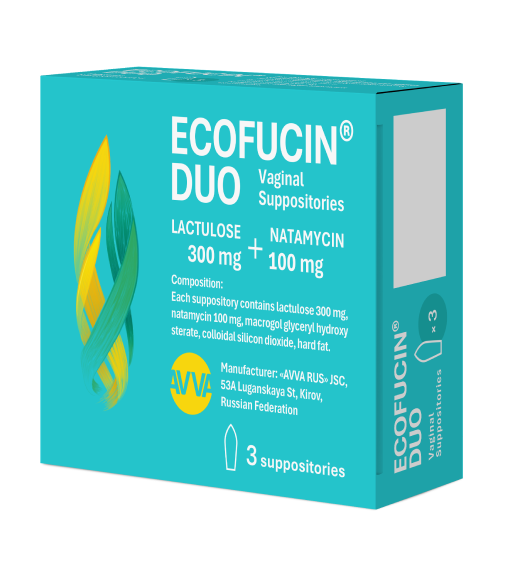
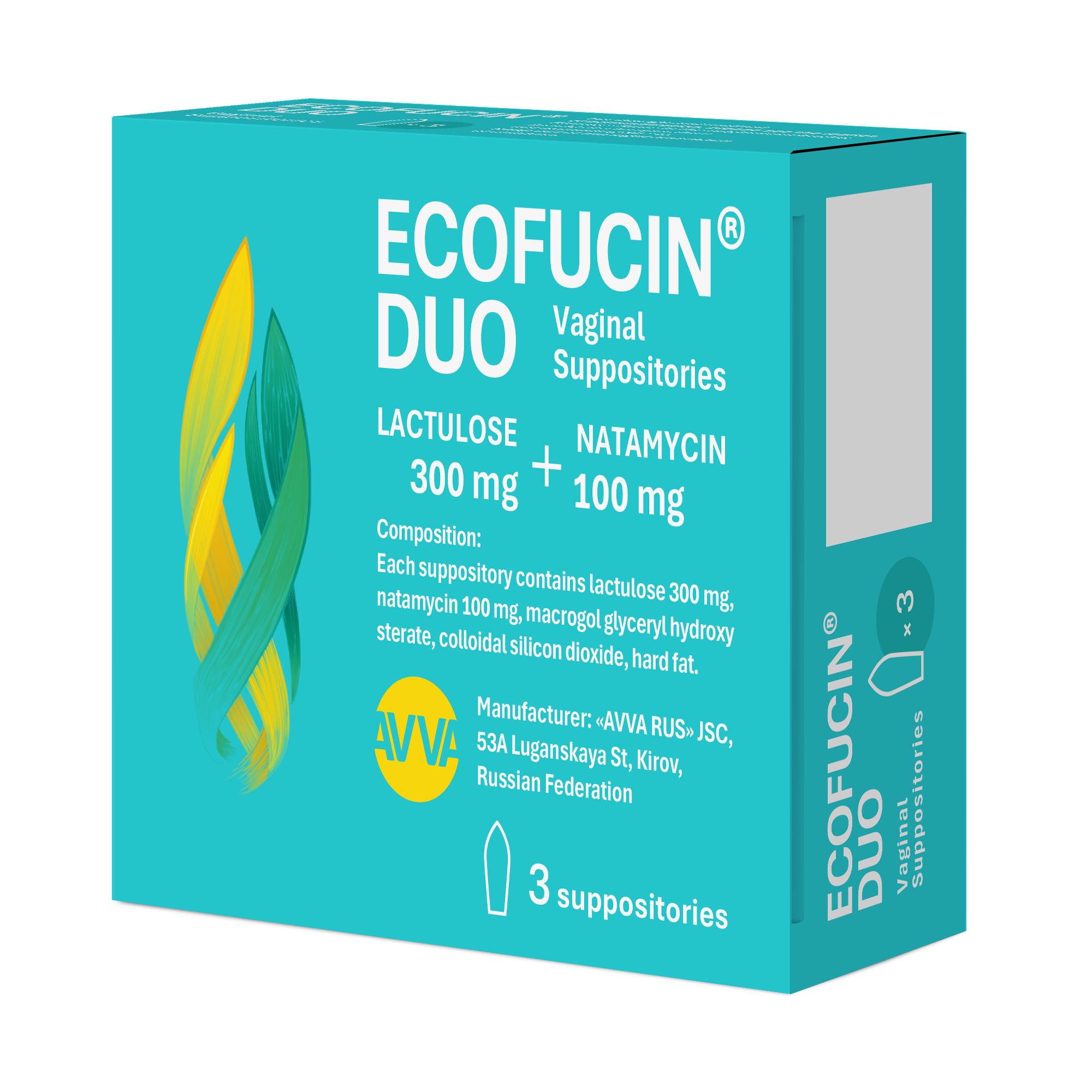
Ecofucin® DUO is the first fixed-dose combination (FDC) vaginal suppository uniting Natamycin — a broad-spectrum polyene antifungal — with Lactulose, a prebiotic disaccharide. In a single 6-day course, it simultaneously eliminates vulvovaginal candidiasis (VVC) and actively restores the protective vaginal Lactobacillus flora, addressing both the acute infection and the microbiome imbalance that underlies recurrence.

✔ Superior Clinical Recovery
81.6% symptom-free by Day 7 — significantly superior to Pimafucin® monotherapy (62.3%) and lactulose alone (42.9%) Source: Volkova et al. BMC Women’s Health 2025;25:77.
✔ Dual-Action Formula
Natamycin eradicates Candida spp. including azole-resistant strains. Lactulose simultaneously re-establishes protective Lactobacillus populations through short-chain fatty acid production.
✔ Superior & Sustained Clinical Recovery
90.8% clinical recovery at Day 20–27 vs 78.2% for Pimafucin® monotherapy (p=0.021). 90.8% microscopic Candida clearance confirmed by KOH microscopy — non-inferior to Pimafucin® for fungal eradication.
✔ Safe in Pregnancy & Lactation
Both components act locally with <3% systemic absorption. No teratogenic effects. Suitable for use in all trimesters of pregnancy and during lactation.
|
What Is VVC? Vulvovaginal candidiasis is a common fungal infection caused by Candida spp. (predominantly Candida albicans). It is characterised by white or yellowish-white curd-like vaginal discharge, vulvar itching, burning, and dysuria. VVC is associated with a high recurrence rate and rising azole resistance — making microbiome restoration alongside antifungal therapy the current standard of care. |
Candida proliferates into its pathogenic hyphal form when protective vaginal Lactobacillus species are depleted. Effective treatment must both eradicate the pathogen and restore the microbiome barrier — the principle behind Ecofucin® DUO’s dual-action design.
•Lactulose fermentation by residual Lactobacillus produces short-chain fatty acids (lactic, acetic, formic) that inhibit Candida re-colonisation.
•Natamycin does not inhibit Lactobacillus growth — enabling simultaneous antifungal and prebiotic activity.
•At Day 20–27 (Visit 3), vaginal Lactobacillus colony counts were significantly higher in the Ecofucin® DUO group than in Pimafucin® (p<0.001) and Lactulose-only (p=0.028)
| Type | Ingredient | Mechanism & Role | Patient Benefit |
|---|---|---|---|
| ACTIVE | Natamycin 100 mg | Broad-spectrum polyene antifungal. Binds fungal cell membrane sterols, increasing membrane permeability and causing cell lysis. Highly active against Candida spp., including azole-resistant strains. | Eradicates Candida — 90.8% mycological clearance at Day 20–27 (Visit 3) |
| ACTIVE | Lactulose 300 mg | Synthetic prebiotic disaccharide (galactose + fructose). Fermented by normal vaginal microflora to produce short-chain fatty acids (lactic, acetic, formic) that inhibit Candida growth and promote Lactobacillus colonisation. | Restores vaginal eubiosis — significantly higher Lactobacillus counts vs Pimafucin® (p<0.001) and vs Lactulose (p=0.028) at Day 20–27 |
| EXCIPIENT | Hard Fat (Suppository Base) | Melts smoothly at body temperature, ensuring even intravaginal release of both active substances across the vaginal mucosa. | Consistent, comfortable local delivery |
Why Lactulose Changes Everything
Standard natamycin monotherapy clears the infection but leaves the vaginal microbiome vulnerable to Candida re-colonisation. Lactulose in Ecofucin® DUO selectively stimulates the growth of beneficial Lactobacillus spp. that were suppressed during VVC — converting antifungal therapy into a comprehensive microbiome-restoring treatment. Clinical evidence confirms significantly higher Lactobacillus counts at Day 20–27 in Ecofucin® DUO patients compared to Pimafucin® monotherapy (p<0.001) and lactulose monotherapy (p=0.028).
| Dosage Form | Vaginal suppositories |
| Available Packs | 3 suppositories per pack or 6 suppositories per pack |
| Strength | Natamycin 100 mg + Lactulose 300 mg per suppository |
| Route | Intravaginal only |
| Storage | Store as per product label; keep out of reach of children |
| Rx Status | Prescription only |
| Indication: Treatment of vulvovaginal candidiasis (VVC) in adult women. |
|
DAYS 1–6 1 suppository intravaginally at bedtime Once-daily dosing |
DAY 7 81.6% clinical recovery (symptom-free) Visit 2 — Primary Endpoint |
DAY 20–27 90.8% clinical recovery; 90.8% microscopic Candida clearance Visit 3 — Sustained Response |
| 1 Remove the suppository from the pack. |
| 2 Lie on your back with knees bent towards your chest. |
| 3 Gently insert the suppository as deeply as possible into the vagina using your middle finger. |
| 4 Repeat once nightly at bedtime for 6 consecutive days. |
✔ Avoid vaginal insertion devices (tampons, spermicides, sprays, diaphragms, condoms) during the treatment course.
✔ Complete the full 6-day course even if symptoms improve before the course ends.
✔ Effective contraception required during treatment and for 3 weeks after completion.
| Study Reference: Volkova et al. Efficacy and safety of natamycin + lactulose vs natamycin monotherapy vs lactulose in acute VVC. BMC Women’s Health. 2025;25:77. DOI: 10.1186/s12905-025-03616-3. |
| Study Type | International, randomised, controlled, assessor-blinded, superiority clinical trial |
| Sites | 6 sites — Russia (1) and Belarus (5) |
| Period | December 2022 to July 2023 |
| Patients | 218 females, aged 18–60 years, with confirmed VVC (clinical + microscopic diagnosis) |
| Ecofucin® DUO Group | 92 patients — Natamycin 100 mg + Lactulose 300 mg, 1 suppository/day × 6 days |
| Pimafucin® Group | 90 patients — Natamycin 100 mg monotherapy, 1 suppository/day × 6 days |
| Lactulose Group | 36 patients — Lactulose 300 mg monotherapy, 1 suppository/day × 6 days |
| Diagnosis Method | Clinical signs + microscopic examination (native vaginal specimen ± 10% KOH) |
| Assessment Points | Visit 2 (Day 7 ± 1) and Visit 3 (Day 20–27 ± 1); total study duration 34 ± 2 days |
| Trial Registration | NCT06411314 |
|
Clinical Recovery at Day 7 — Primary Endpoint (n = 218) Ecofucin® DUO superior to both comparators • p < 0.001 • Volkova et al. BMC Women’s Health 2025;25:77 |
||
|
81.6% Ecofucin® DUO (Natamycin + Lactulose) |
62.3% Pimafucin® (Natamycin monotherapy) |
42.9% Lactulose only |
| Ecofucin® DUO: +18.4 percentage points vs Pimafucin® | +38.8 percentage points vs Lactulose alone (p < 0.001) | ||
| Assessment Point | Ecofucin® DUO Candida absent | Pimafucin® Candida absent | Lactulose only Candida absent | Statistical Significance |
|---|---|---|---|---|
| Day 7 ± 1 (Visit 2) | 75.9% (69/87) | 71.3% (65/87) | 45.7% (16/35) | Ecofucin® DUO vs Lactulose: p=0.001 Ecofucin® DUO vs Pimafucin®: p=NS |
| Day 20–27 ± 1 (Visit 3) | 90.8% (79/87) | 88.5% (77/87) | 74.3% (26/35) | Ecofucin® DUO vs Lactulose: p=0.017 Ecofucin® DUO vs Pimafucin®: p=NS |
|
How to Read This Table Microscopic recovery = confirmed absence of Candida spp. on vaginal microscopy (native specimen + 10% KOH). This is a measure of fungal eradication only — it is different from clinical recovery (symptom resolution). Key finding: Ecofucin® DUO and Pimafucin® eradicate Candida at equivalent rates at both assessment visits (p=NS). Both are significantly superior to lactulose alone for Candida eradication. The clinically meaningful advantages of Ecofucin® DUO over Pimafucin® are in (1) superior clinical recovery at both visits and (2) significantly superior Lactobacillus microbiome restoration — shown in the sections below. |
| Assessment Point | Ecofucin® DUO | Pimafucin® | Lactulose only | Statistical Significance |
|---|---|---|---|---|
| Day 7 ± 1 (Visit 2 — Primary) | 81.6% (71/87) | 62.3% (55/87) | 42.9% (15/35) | vs Pimafucin®: p=0.005 ✔ vs Lactulose: p<0.001 ✔ |
| Day 20–27 ± 1 (Visit 3 — Secondary) | 90.8% (79/87) | 78.2% (68/87) | 62.9% (22/35) | vs Pimafucin®: p=0.021 ✔ vs Lactulose: p<0.001 ✔ |
Clinical recovery = complete absence of VVC symptoms (discharge, itching, burning, dysuria). Ecofucin® DUO is statistically superior to Pimafucin® at both assessment visits. Source: Volkova et al. BMC Women’s Health 2025;25:77.
| At Day 20–27 (Visit 3): The number of vaginal Lactobacillus colonies was significantly higher in the Ecofucin® DUO group compared to Pimafucin® (p<0.001) and lactulose-only (p=0.028). In patients with low baseline Lactobacillus content, Ecofucin® DUO increased vaginal Lactobacillus levels to reference values in 15.4% of patients at Day 7 (95% CI: 2.03–28.7) and 20.9% at Day 20–27 (95% CI: 5.91–35.85). Pimafucin® monotherapy and lactulose monotherapy had no effect on the number of patients with normal lactobacilli levels at either visit. |
| BEFORE — VVC State | AFTER — Restored Flora | Dual-Action Advantage |
|
✗ Candida spp. overgrowth (hyphal form) ✗ Depleted vaginal Lactobacilli ✗ Disrupted vaginal pH ✗ White/curd-like discharge ✗ Vulvar itching, burning, dysuria ✗ Microbiome dysbiosis |
✔ Candida eradicated (90.8% microscopic clearance at Day 20–27) ✔ Vaginal Lactobacilli significantly restored vs Pimafucin® (Day 20–27, p<0.001) ✔ Healthy vaginal pH maintained ✔ Symptoms resolved in 81.6% of patients (Day 7) ✔ No severe adverse events reported ✔ Microbiome eubiosis re-established |
Natamycin eliminates Candida. Lactulose simultaneously re-establishes Lactobacillus flora — addressing both the infection and the root cause of recurrence. Day 20–27: Lactobacillus counts significantly higher vs Pimafucin® (p<0.001) and vs Lactulose-only (p=0.028). |
© 2026 ADAS Pharmaceuticals FZCO All Rights Reserved. Designed By Mightywarner Technologies