


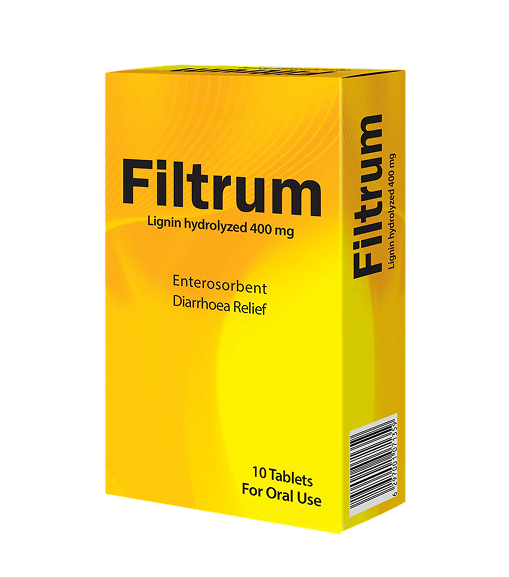
Enterosorbent — Diarrhoea Management
Non-systemic • Universal Broad-Spectrum Sorption • Natural Wood Origin
Filtrum® is a non-systemic, universal enterosorbent for the management of diarrhoea. It contains Lignin Hydrolyzed — a polymer of wood origin, a polysaccharide with a developed porous structure obtained by acid hydrolysis of wood.
Lignin Hydrolyzed possesses a high sorption spectrum activity and pronounced affinity to pathogenic microorganisms and toxins, without affecting commensal bacteria. Filtrum® provides a unique approach to the management of acute diarrhoea of various causes.

|
🌿 Natural Origin
Derived from wood by acid hydrolysis. Not metabolised or absorbed by the intestine — purely local action within the GI tract. |
✔ Broad-Spectrum Sorption
Variable pore size enables sorption of substances ranging from low molecular weight gases and heavy metals to complex microorganisms. |
|
✔ Selective Activity
High affinity to pathogenic microorganisms and toxins. Does not affect commensal gut flora — no impact on healthy intestinal microbiome. |
✔ Universal Indication
Effective across all common causes of acute diarrhoea: bacterial infection, viral gastroenteritis, food poisoning, food allergy, and drug side effects. |
| In 1985, “enterosorption” was defined as the method of enteral sorption detoxification. The sorbents used in this method are called enterosorbents. Filtrum® (Lignin Hydrolyzed) is classified as an associated enterosorbent — it decreases intoxication irrespective of toxin origin, ranging from low molecular substances to bacteria, making it an effective first-aid means in acute disorders of unspecified origin. |
|
Sorption Capacity vs Activated Charcoal Lignin Hydrolyzed (Filtrum®) vs Activated Charcoal across molecular weight spectrum |
||
| Low Molecular Weight (gases, heavy metals) | Medium Molecular Weight (protein complexes, endotoxins, mycotoxins, alkaloids, bilirubin, cholesterol) | High Molecular Weight (bacteria and microorganisms) |
| Filtrum® (Lignin Hydrolyzed): Variable pore structure — maximum sorption capacity across all molecular weights. Sorbs low-weight substances, protein complexes, endotoxins, mycotoxins AND bacteria. | ||
| Activated Charcoal: Micro-pore structure only — effective for low molecular weight substances. Substantially reduced sorption capacity for medium-weight substances; no significant activity against bacteria and microorganisms. | ||
| Filtrum® (Lignin Hydrolyzed) is 1,000× more effective than activated charcoal in neutralising pathogenic bacteria in the gastrointestinal tract | ||
|
Safety confirmed in animal studies (white rats, n=6–10 per group, 10 days administration):
✔ Filtrum®: No visual or morphological changes to mucous coat of stomach or intestine after 10 days. ✔ Activated Charcoal: Inflammatory reaction developed in mucous coat of GI tract after 10 days — edema of submucous layer, chronic jejunitis. |
Composition & Product Specifications
| Type | Ingredient | Mechanism & Role | Key Property |
| ACTIVE SUBSTANCE | Lignin Hydrolyzed 400 mg | Natural polysaccharide polymer obtained by acid hydrolysis of wood. Developed variable pore structure enables binding and neutralisation of toxins, pathogens, metabolites, and allergens across the full molecular weight spectrum. Not metabolised or systemically absorbed — acts entirely within the intestinal lumen. | 1,000× more effective than activated charcoal vs pathogenic bacteria |
| Dosage Form | Film-coated tablets, 400 mg |
| Pack Size | Blister strips of 10 tablets |
| Storage | Store below 300 C ; keep out of reach of children |
|
Filtrum® is indicated for the management of acute diarrhoea of various causes:
· Intestinal infection (Acute Enteric Infection) — including food poisoning and Traveller’s diarrhoea · Food intolerance and food allergy
|
Filtrum® is the only treatment option effective across all aetiological categories of acute diarrhoea — a unique advantage in a clinical setting where the precise cause is often unknown at the time of first presentation.
| Cause of Diarrhoea | Antibiotics | Loperamide | S. boulardii | Filtrum® |
| Bacteria | + | Contraindicated (Salmonella / Shigella) | + | + |
| Viruses | − | − | − | + |
| Other (Parasites, Mycotoxins) | ± | − | − | + |
| + = Effective · − = Not effective · ± = Partial/limited efficacy · Filtrum® is the only option effective across all aetiological categories | ||||
|
Key Conclusions Across All Studies:
Study 1 (Uchaykin et al., 2002): Filtrum® + Furazolidone achieved diarrhoea resolution in 75% of children by Day 3 vs 35% with Furazolidone alone. Complete resolution (100%) by Day 5 in the Filtrum® group vs Day 7–8 with Furazolidone monotherapy. Infectious toxicosis resolved in 90% by Day 3 vs 50% in the control group. Study 2 (Luchev et al., 2001): Average diarrhoea duration 1.05 ± 0.05 days (SoC + Filtrum®) vs 2.43 ± 0.22 days (SoC alone) — 57% faster resolution (p < 0.01). All four core symptoms — fever, diarrhoea, abdominal pain, atony/anorexia — resolved significantly faster with Filtrum® (p < 0.01 for all). Study 3 (Novokshenov et al., 2009): Stool normalisation by Day 3 in 80% of patients (SoC + Filtrum®) vs 33.3% (SoC alone) in viral AEI in children aged 3–13. No adverse events occurred. Filtrum® is the only treatment effective across all AEI causes (bacterial, viral, and other including parasites and mycotoxins) — can be used as monotherapy in mild forms or in combination with antibiotics for moderate forms. |
| Patients | 40 children, ages 1–14 |
| Group 1 | 20 patients — Furazolidone |
| Group 2 | 20 patients — Furazolidone + Filtrum® |
| Condition | Acute Enteric Infections (AEI) |
Dynamics of Clinical Symptoms — Number of patients whose symptoms disappeared:
| Symptom | Day 1 | Day 2 | Day 3 | Day 4 | Day 5 | Day 7–8 | Group |
| Infectious Toxicosis | — | 4 (20%) | 10 (50%) | 17 (65%) | 20 (100%) | — | Gr 1 (Furazolidone) |
| 1 (5%) | 10 (50%) | 18 (90%) | 19 (95%) | 20 (100%) | — | Gr 2 (+ Filtrum®) | |
| Fever | 9 (45%) | 15 (75%) | 18 (90%) | 18 (90%) | 20 (100%) | — | Gr 1 |
| 10 (50%) | 19 (95%) | 20 (100%) | — | — | — | Gr 2 | |
| Diarrhoea | — | 1 (5%) | 7 (35%) | 8 (40%) | 13 (65%) | 20 (100%) | Gr 1 |
| 2 (10%) | 7 (35%) | 15 (75%) | 18 (90%) | 20 (100%) | — | Gr 2 |
|
Conclusions (Uchaykin et al., 2002):
1. Filtrum® provides a fast and pronounced anti-diarrhoeal effect and significantly reduces the duration of the acute period of the disease in comparison with conventional Furazolidone therapy of AEIs. 2. Enterosorption with Filtrum® can be administered as monotherapy in mild forms and in combination with Furazolidone for moderate forms of AEIs in children. |
| Patients | 60 patients, ages 17–80 |
| Group 1 | 45 patients — Standard of Care + Filtrum® |
| Group 2 | 15 patients — Standard of Care alone |
| Conditions | Acute dysentery, gastrointestinal salmonellosis, gastroenteritis form of food poisoning |
Average Duration of Symptoms (days):
| Symptom | Group 1: SoC + Filtrum® (n = 45) — Average days | Group 2: SoC alone (n = 15) — Average days | p-value |
| Fever | 1.22 ± 0.1 | 3.26 ± 0.45 | < 0.01 |
| Diarrhoea | 1.05 ± 0.05 | 2.43 ± 0.22 | < 0.01 |
| Abdominal pain | 2.00 ± 0.20 | 2.50 ± 0.28 | < 0.01 |
| Atony / Anorexia | 1.52 ± 0.11 | 3.13 ± 0.24 | < 0.01 |
|
Conclusions (Luchev et al., 2001):
· Administered with standard of care, Filtrum® showed high clinical efficacy in the treatment of acute enteric infections accompanied by diarrhoea: acute dysentery, gastrointestinal form of salmonellosis, and gastroenteritis form of food poisoning; characterised by reduction in duration of core clinical signs. · Filtrum® can be recommended as a drug of choice in mild and moderate forms of AEIs. |
| Patients | 45 children, ages 3–13 |
| Group 1 | 15 patients — Standard of Care alone |
| Group 2 | 30 patients — Standard of Care + Filtrum® |
| Condition | Acute intestinal infections of viral aetiology (gastroenteritis) — moderate forms |
Dynamics of Clinical Symptoms — Number of patients whose symptoms disappeared:
| Symptom | Day 1 | Day 2 | Day 3 | Day 4 | Day 5 | Group | Result |
| Infectious Toxicosis | 0 | 3 (20%) | 13 (86.7%) | 15 (100%) | — | SoC (Gr 1) | |
| 4 (13.3%) | 18 (60%) | 30 (100%) | — | — | SoC + Filtrum® (Gr 2) | Resolved by Day 3 | |
| Anorexia | 0 | 6 (40%) | 14 (93.3%) | 15 (100%) | — | SoC | |
| 9 (30%) | 29 (96.7%) | 30 (100%) | — | — | SoC + Filtrum® | Resolved by Day 3 | |
| Flatulence | 1 (6.7%) | 5 (33.3%) | 11 (73.3%) | — | — | SoC | |
| 4 (13.3%) | 23 (76.7%) | 30 (100%) | — | — | SoC + Filtrum® | Resolved by Day 3 | |
| Fever | 1 (6.7%) | 8 (53.3%) | 13 (86.7%) | 15 (100%) | — | SoC | |
| 18 (60%) | 29 (96.7%) | 30 (100%) | — | — | SoC + Filtrum® | Resolved by Day 3 | |
| Diarrhoea (stool norm.) | 0 | 2 (13.3%) | 5 (33.3%) | 12 (80%) | 15 (100%) | SoC | |
| 5 (16.7%) | 14 (46.7%) | 24 (80%) | 28 (93.3%) | 30 (100%) | SoC + Filtrum® | 80% on Day 3 |
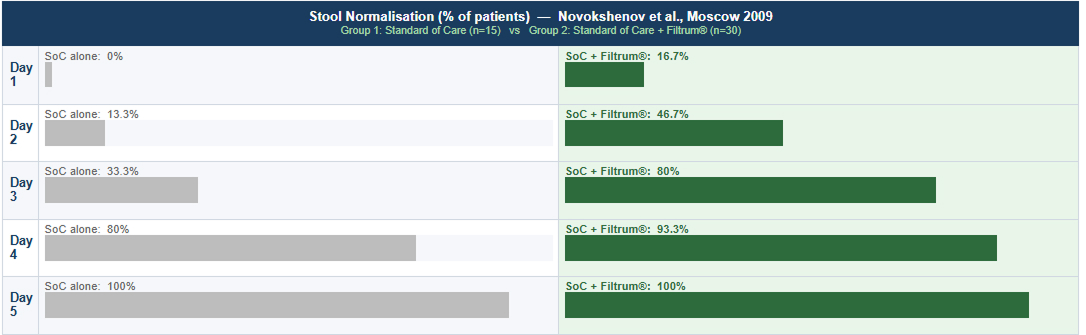
Conclusions (Novokshenov et al., 2009):
No adverse events occurred. On Day 2, 5 patients (16.6%), and on Day 3/4, 10 patients (33.3%) had not passed stool for 1 or 2 days.
© 2026 ADAS Pharmaceuticals FZCO All Rights Reserved. Designed By Mightywarner Technologies